
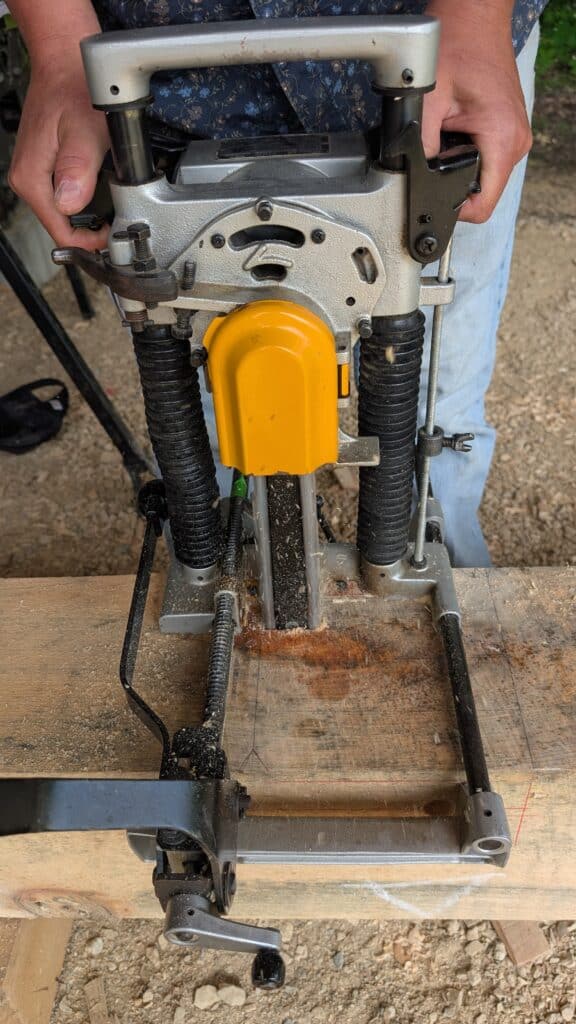
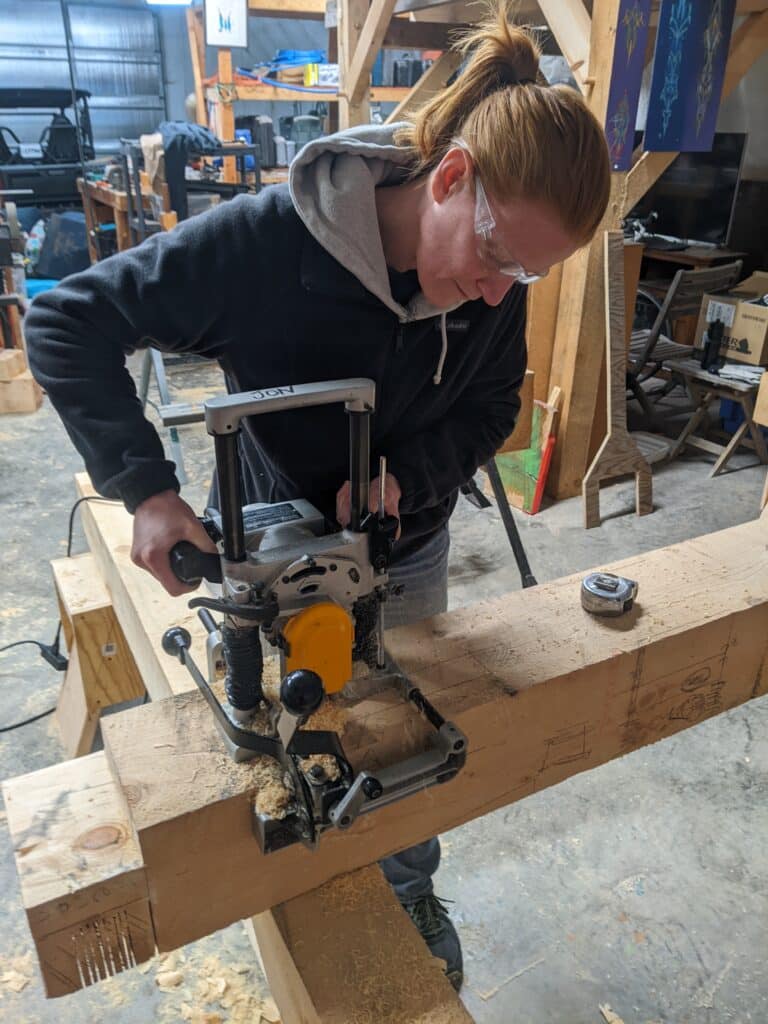
if you spend much time around timber framing, sooner or later you’re going to run into a chain mortiser.
and if you’re around enough timber framers, the one you’ll probably see most often is the makita 7104l.
there are other chain mortisers out there, but the makita is really the workhorse. for a lot of timber framers, this is the one they buy. it’s proven, it does the job, and it has become a standard tool in a lot of shops and on a lot of job sites.
what it does
in timber framing, we’re cutting mortises to receive tenons. that mortise is one of the basic building blocks of the joinery.
before tools like this were common, a mortise would typically be cut by drilling a series of holes to hog out most of the wood with a large drill bit. then you’d come back with a chisel and mallet to square it up, clean it out, and bring it to final shape.
that method still works. there’s nothing wrong with it.
but a chain mortiser speeds that process up a lot.
the makita 7104l lets you remove that material quickly and cut a clean mortise in heavy timber in a way that is efficient, repeatable, and practical.
why it matters
tools like this are part of what make modern timber framing workable for a lot of people.
timber framing still depends on layout, understanding, and careful work. a machine does not fix bad layout. it does not replace knowing what you’re doing. and it definitely does not replace judgment.
but once the timber is laid out correctly, the chain mortiser becomes a very practical way to turn those lines into real joinery.
that’s why this tool matters.
it’s not magic. it’s not doing the thinking for you. it’s just a very effective way to do real work.
why the makita is so common
the makita 7104l has earned its place because it is a dependable tool.
it’s widely used because:
- it works
- it holds up
- it cuts clean mortises
- it’s accessible enough that a lot of framers can realistically own one
for many people getting serious about timber framing, this is the chain mortiser they end up with.
tools are not the starting point
one thing worth saying clearly is that tools are not the beginning of the craft.
people often see a tool like this and get fascinated by it, which makes sense. it’s a great tool. it’s satisfying to watch. it does serious work.
but the real beginning is still understanding the process.
you need to understand layout. you need to understand what the joint is doing. you need to understand why the mortise is where it is and what it needs to receive.
that’s the part that matters most.
the tool helps you do the work. it does not teach you the craft.
getting into timber framing
for a lot of people, seeing a chain mortiser in action is one of those moments that sparks interest in timber framing.
it’s a real craft. real tools. real process. real joinery.
and for a lot of people, the question becomes: where do i start?
that’s exactly why we put together the star hill manual.
it lays out the star hill approach and gives you a clear path into timber framing.
if you want to get started, start there:
build. remember. repeat.
if you want, i can also tighten this one more pass so it sounds even more like your natural speaking cadence.
